background image
Aqua Diary
  • Community Aquariums
  • Articles
  • Install
  • Log In
Aqua DiaryAqua Diary
  • Terms of Service
  • Privacy Policy
  • Cookies
  • Data Deletion
  • Help & Support
  • Website Map
Aqua Diary © 2026 All rights reserved.
Snow White
Shrimp

Snow White

Caridina cf. cantonensis "Snow White"

Taxonomy

Phylum:
Arthropoda
Subphylum:
Crustacea
Class:
Malacostraca
Order:
Decapoda
Suborder:
Pleocyemata
Family:
Atyidae
Genus:
Caridina

About the species

Key features:
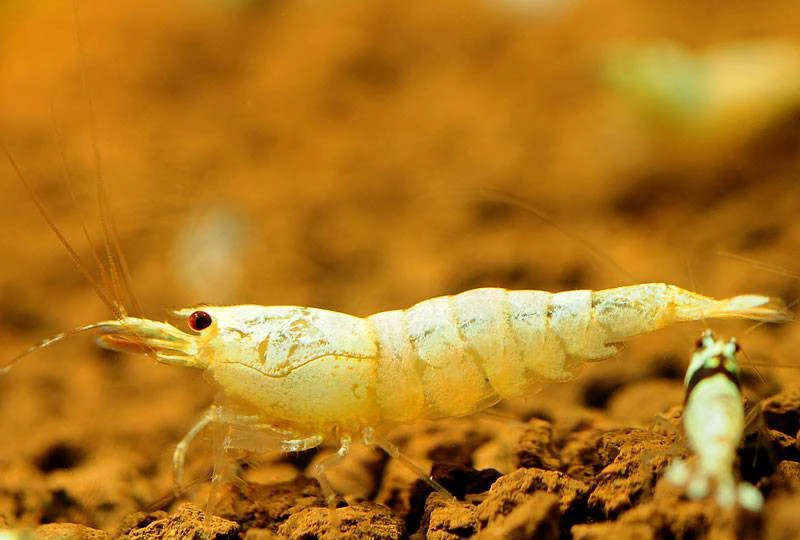
The Snow White has a predominantly white opaque coloration, although it may have blue or pink cheeks. There is also an entirely blue colour form, the Blue Bolt.
Origin:
China, Taiwan
Coloration:
Colorful

Tank

Nano tank:
Yes
Species tank:
No
Min. group:
10 pcs
Light:
Tolerates strong light
Special requirements:
Hiding places

Plants

Plants in the tank:
Yes
Behavior toward plants:
Nibbles when hungry

Food and tankmates

Food

Blanched lettuce
Nettle leaves
Beech leaves
Flake food
Frozen food
Cucumber
Carrots
Live food
Catfish tablets

Breeding

Development type:
Direct (young look like adults)
Number of young:
20–30 juveniles
Clutch size:
20–30 eggs
Frequency:
Every 4–6 weeks under good conditions

Description

The Snow White is a very beautiful form of the Red Bee. It often has a white opaque coloration, while some pink or blue may sometimes show through on the cheeks. There are also entirely blue colour forms, which are called Blue Bolt. The animals prefer a pH of approximately 6–7.5, a carbonate hardness of 0–5° and a general hardness of approximately 1–10°. Conductivity should be between 80 and 400 µS, although successful breeding has already been achieved at a conductivity of 937 µS. Females of this species grow to approximately 3–3.5 cm in length, whereas males only reach approximately 2.5–3 cm.

The Snow Whites are essentially divided into three grades:

Low: There are many colourless areas; the legs have little coloration.

Mid: No large colourless areas; the legs are reasonably well pigmented; a golden base colour shows through (also called Golden Snow White).

High: The animal is almost perfectly patterned; only minimal colourless areas are visible; the legs are well coloured.

There is also another grade, although it is not often used:

Super High Snowflake: The animal has a bright, clear white coloration; the legs are perfectly coloured; there are no colourless areas.

It is still unclear whether the Snow White is a mutation or whether breeders eliminated the animals’ red coloration through targeted breeding and selection.

How breeding happens

Breeding the Snow White is very similar to breeding the Red Bee and Black Bee. The animals prefer slightly acidic water, in which they often also display better colours. Once sexually mature, females develop a saddle behind the head when water quality is good and the water parameters are suitable. At the next molt, the male attaches a spermatophore to the female, which then attempts to press the eggs previously produced behind the head into her abdominal brood pouch. There should normally be approximately 20–30 eggs. Inexperienced females often lose a number of the eggs, and sometimes all of them. After approximately four weeks, the female releases the juveniles, which immediately hide in moss. There they graze surfaces for microorganisms and are constantly searching for food. At this still-young age, molting occurs relatively frequently. However, its frequency steadily decreases with age. The animals reach sexual maturity at approximately 3–3½ months. The use of juvenile-rearing food is recommended to achieve better survival rates.